

Feeling overwhelmed?
Welcome to my new low-tech weekly planning system

At the end of last year, I had a conversation with the wonderful Sarah Hart-Unger that made me rethink my rather curmudgeonly outlook on longer-range planning.
Definitely listen to the full conversation — and get Sarah’s book, Best Laid Plans: A Simple Planning System for Living a Life That You Love. In a nutshell, she helped me reframe my commitment-phobe perspective to one where the act of longer-range planning means protecting space for the things I care about, as well as adding in meaningful things.
That conversation led me to develop a sketch of the coming year and a monthly planning ritual, which I share about in this episode:
And this system served me well — until it didn’t. Over the last few months I’ve been deeply immersed in work around my strategic advisory practice. It has been amazing and it’s also been a lot. And the reality is, adding on a tremendous amount of learning and doing for my practice on top of my current clients, podcast, Substacks, and everyday adulting left me feeling pressed to the edges and overwhelmed.
Incidentally, the point where I knew I needed to enact change was reflective of something I say to my clients when I can sense that they are about to boil over: “If you’re going to bed, waking up, or falling asleep fretting about something, it’s time to do something different.”
After several nights of crappy sleep — going to bed, waking up, and falling asleep fretting about to-do’s, what I might be forgetting, and whether I was behind on things — I sat down to think about my pain points and what to do about them. I want to share about this process because it has been so helpful and I hope it might offer relief if you’re in a similar boat.
The problem: A planning gap
I took a quick inventory of how I was keeping the balls in the air:
I was already doing my monthly holistic planning, which I referred to above.
I was already doing a quick calendar look ahead on Fridays and then a refresh on Monday to get a sense of what was on tap and what that meant for my blocks of actual working time.
I was already using Todoist as my air tight capture system for tasks (here’s a quick episode on how I use Todoist).
It didn’t take long to realize that I was missing a layer between planning and action in terms of what is truly essential on a given week. And while it is possible to priority-flag items in Todoist, since I usually have 40-50 granular tasks on any given weekday, each morning I found myself arriving at my morning planning check-in already feeling scrambled and overwhelmed.
So here’s what I did.
Identified the system
I always say that any kind of system — planning, to-do’s, etc. — needs to live in a system you will use and enjoy and be able to access easily. Friction kills. I knew I did not want something involved like Monday or Basecamp. Quite frankly, I didn’t want to learn anything new.
I decided to keep it simple and use a simple Google doc as my command center since I am always in this platform.
Evolved my command center
I started with a simple bullet view of high level buckets (e.g., current clients), primary sub-bullets (e.g., client names), then secondary sub-bullets (e.g., priority items within clients). However, I found this format hard to scan as I started to map out my workstreams.
I sat with this challenge for a day and kept thinking through my gap. And then I realized what I needed: A simple table inside of Google docs. It’s a seemingly minor thing, but having clear cell alignment created calm and was more scannable.
Here’s how I built the system: it’s a basic four-column table.
Column 1: My workstreams including the broad categories of business strategy and development, current clients, podcast, Substacks, and personal. I added sub-levels for the projects within each workstream, resulting in 15 workstream rows.
Columns 2 to 4: This is where I had my breakthrough. I realized I needed three columns.
This Week (column 2) helps me see what is absolutely essential amidst what ends up being 200-250 granular tasks rolling through my Todoist in a week. Yikes. Just writing that out makes me realize why this layer is so essential.
Next Week (column 3) helps mentally account for actions that are in the immediate wings but not urgent this week.
This Month (column 4) helps me keep an eye on bigger project elements, which are at risk of getting buried if I’m too in the weeds with details.
Some tactical experimentation notes
At first I thought I would maintain a practice of setting up my weeks on Friday and reviewing on Monday, but now I keep this Google doc open all the time. I check it first thing every weekday morning to orient myself on what I need to focus on.
When I started to put this system into practice I used strike through for items I completed but left them in the grid because I thought it would be satisfying to see what was getting done. It ended up feeling too cluttered. Now the goal is empty space. Once I complete a weekly priority I delete it from the table.
Each morning, I scan the buckets and highlight what absolutely needs to get done that day. This is really helpful to keep me focused.
I am still in lock step with Todoist. It provides all the granular details and many to-do’s that are ongoing inside of weekly action items.
I know life is a continual moving target, but this system is reducing my mental load — helping with my sense of overwhelm and worry about missing the key pieces. I am thrilled about it and hope this helps you if you’re similarly juggling lots of action items across multiple workstreams.
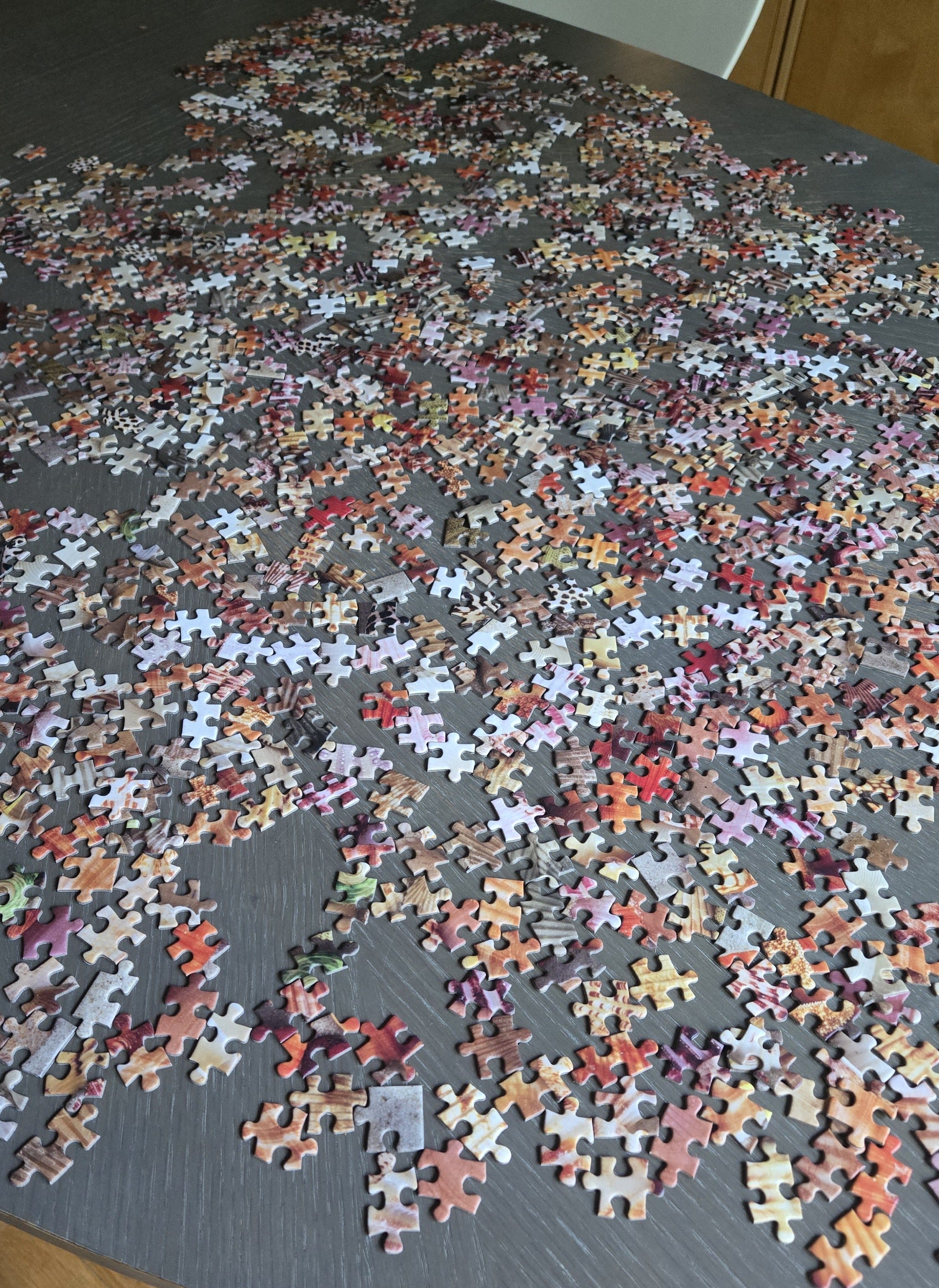
Another great think about thinking through the puzzle that is my schedule? It reminded me to get out of my head and break out an actual puzzle. I remembered that I received this vibrant seashells puzzle for my birthday this past fall but was waiting to open it until the summer. The pieces are all flipped and I’m excited to tuck into this. Our dining table is still extended from Laurel’s graduation/send-off party and I love that the’re a beautiful new backgammon board and this puzzle on it. It kind of sends the message, if you want to sit down and eat, might as well play!
!